

A driver who hit you and fled the scene does not have to get the last word. You still have options. In fact, a hit and run injury claim in Nevada can move forward even without the other driver’s name, through your own insurance coverage, evidence from the scene, and a police report filed within the legal window.
The steps below explain what to do first, how Nevada law defines this crime, and how victims recover compensation when the at fault driver is never found.
What Is a Hit and Run Injury Under Nevada Law?
Under NRS 484E.010, a driver involved in a crash that causes injury or death must stop, provide identifying information, and render aid, and a violation of that duty is a category B felony punishable by two to twenty years in prison and a fine between $2,000 and $5,000. Leaving the scene of a crash that only causes property damage is treated less severely, typically as a misdemeanor under a related statute. This criminal exposure pressures the responsible driver toward being identified, though it does not replace the civil claim you still need to file to recover your own losses.
A Reno car accident attorney who regularly handles these cases will tell you the criminal case and your compensation claim run on separate tracks. Prosecutors decide whether to charge the driver, while your attorney focuses on the insurance side, where the deadlines and evidence rules are different.
What Steps Do I Take After a Hit and Run Injury?
What you do in the hours after a hit and run injury shapes how strong your claim will be later. Priorities include:
- Call 911 and request medical attention, even for injuries that feel minor
- Write down or photograph anything you remember about the fleeing vehicle
- Look for witnesses and nearby surveillance or traffic cameras
- File a police report before leaving the scene, or as soon as possible after
- Photograph your injuries, your vehicle, and the location
- Contact your own insurance carrier to open a claim file
The police report becomes one of the most important documents in a hit and run claim, since it establishes the date, location, and initial description of what happened.
3 Paths to Financial Recovery After a Hit and Run Injury
When the driver who caused your crash cannot be located, compensation usually comes from one of the following sources.
1. Your Own Uninsured Motorist Coverage
Nevada insurers must offer uninsured motorist (UM) coverage on every policy, though drivers may reject it in writing under NRS 687B.145. If you carry UM coverage and never signed a rejection, your own policy can pay medical bills, lost wages, and pain and suffering after a hit and run accident, much like it would if the other driver had been identified and insured. With roughly one in eight or nine Nevada drivers uninsured, this coverage is often the most valuable line on a policy.
2. Health Insurance and Medical Payments Coverage
Medical Payments (MedPay) coverage and your health insurance can cover treatment costs while a claim is pending, regardless of fault. Nevada insurers must offer at least a baseline amount of MedPay, and many drivers carry higher limits. Using these benefits early keeps bills from going to collections while your attorney works the liability side of the case.
3. The Nevada Statute of Limitations
A hit and run injury claim is still bound by NRS 11.190(4)(e), which gives most Nevada personal injury victims two years from the date of the crash to file a lawsuit. Missing that deadline can end your right to compensation even when the underlying evidence of the crash is strong.
When the Filing Deadline Can Pause
Nevada’s discovery rule can delay the start of the two year clock if an injury does not appear right away, and the clock pauses entirely for injured minors until they turn eighteen. These exceptions are narrow and fact specific, which is why confirming your deadline with a Reno personal injury lawyer early in the process protects your claim.
Common Mistakes That Can Hurt a Hit and Run Injury Claim
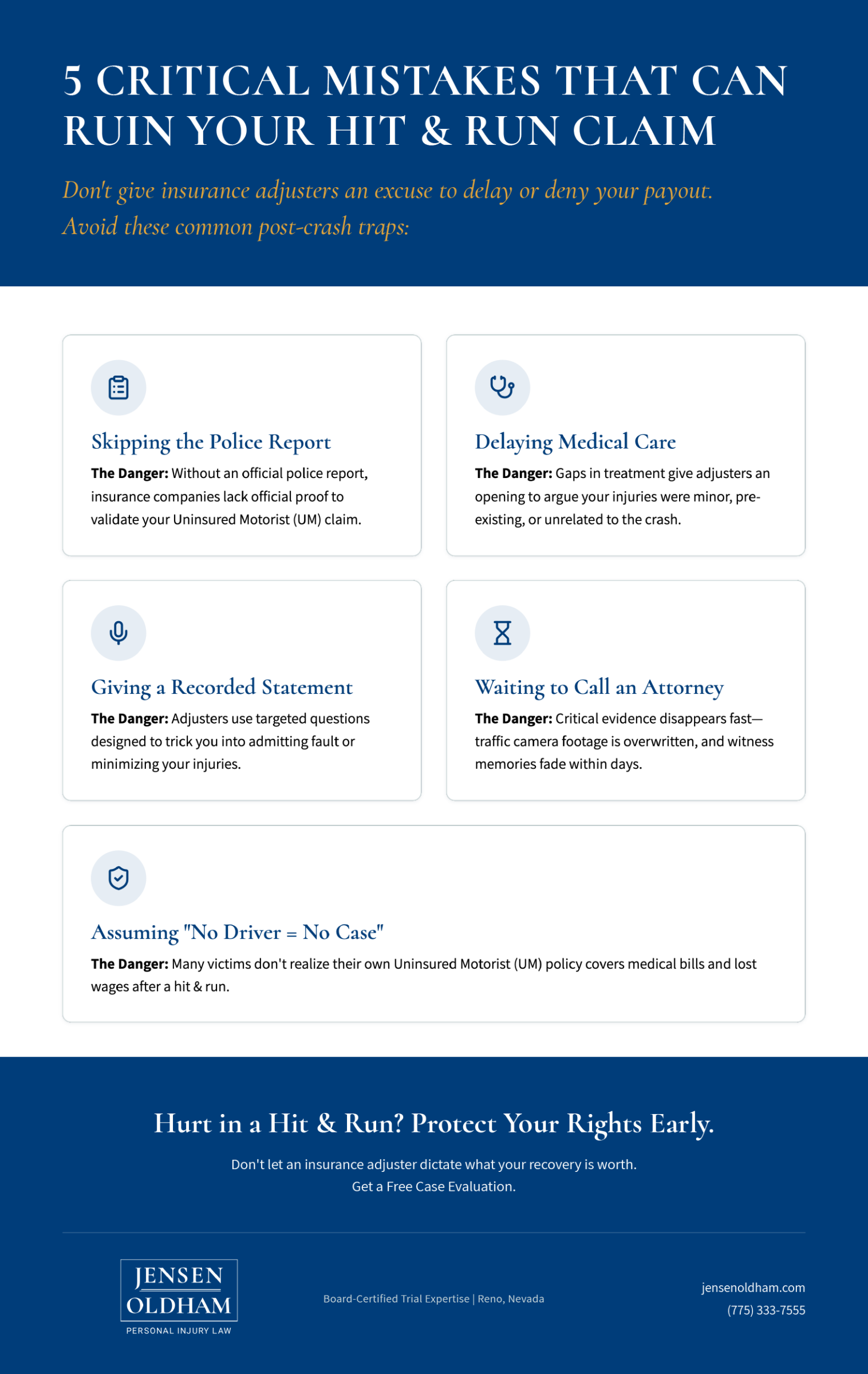
Even a strong claim can lose value if a few early missteps go uncorrected. The mistakes below come up often, and each one gives an insurance adjuster an opening to delay or reduce what you are owed.
- Skipping the police report. Insurers have far less to work with when evaluating your uninsured motorist claim.
- Delaying medical care. Gaps in treatment give adjusters a reason to argue your injuries were minor or unrelated.
- Giving a recorded statement without guidance. Adjusters may ask questions designed to minimize your claim.
- Waiting to consult an attorney. Traffic camera footage and witness memory fade quickly after a hit and run accident.
- Assuming no insurance means no case. Many victims do not realize their own policy can respond to a hit and run injury.
How Jensen Oldham Personal Injury Law Helps Hit and Run Victims
Our firm has represented injured people across Reno, Sparks, Carson City, and Fernley for decades, and we apply that same personal injury case process to cases where the at fault driver is not immediately known. This work often overlaps with cases involving someone hit by a drunk driver, since impaired drivers frequently flee rather than stop. It can even extend to truck driver fatigue when the fleeing vehicle is a commercial truck.
As a car accident lawyer team, we investigate every available lead before turning to your own coverage, and as a personal injury attorney in Reno, our team works on contingency, so you owe nothing unless we recover compensation for you.
Start Your Hit and Run Injury Claim Today
A hit and run injury does not have to leave you without options, and you do not have to
sort through them alone. Between police involvement, your own insurance coverage, and a firm two year filing window, Nevada law gives victims a clear path toward compensation, even when the driver responsible was never caught. If you or someone you love was hurt this way, contact Jensen Oldham Personal Injury Law for a free case evaluation, and let us help you understand exactly what your coverage can do for you.