
If you are wondering how to use digital evidence in court, the most important thing to know is that electronic data, such as dash cam video, Ring doorbell footage, and smartphone GPS, is highly admissible in Nevada, provided it is properly authenticated. In modern personal injury lawsuits, digital evidence is often the strongest tool used to prove fault, refute false statements from the other driver, and force insurance companies to offer maximum settlements before a trial is even necessary.
“A witness might honestly misremember how fast a car was going or what color a traffic light was, but a camera or a vehicle’s black box data does not lie. In modern courtrooms, digital evidence is the ultimate tie-breaker.”
— Bob Jensen, Board-Certified Personal Injury Specialist at Jensen Oldham
What Types of Digital Evidence Are Accepted in Court?
For digital evidence in court to be accepted by a judge, it must cross two main legal thresholds: it must be relevant, and it must be authenticated.
Relevance simply means the digital data directly pertains to your accident, injuries, or the damages you are claiming. Authentication is the slightly more complex hurdle. Your legal team must prove to the court that the video, photo, or data log is a true and accurate representation of the events and has not been altered, spliced, or digitally manipulated. The American Bar Association maintains strict rules regarding the authentication of electronic evidence, which is why you should always hand raw, unedited files directly to your attorney.
Once those legal boxes are checked, almost any digital footprint captured in a public space can be leveraged to support your case.
9 Powerful Types of Digital Evidence in Personal Injury Cases
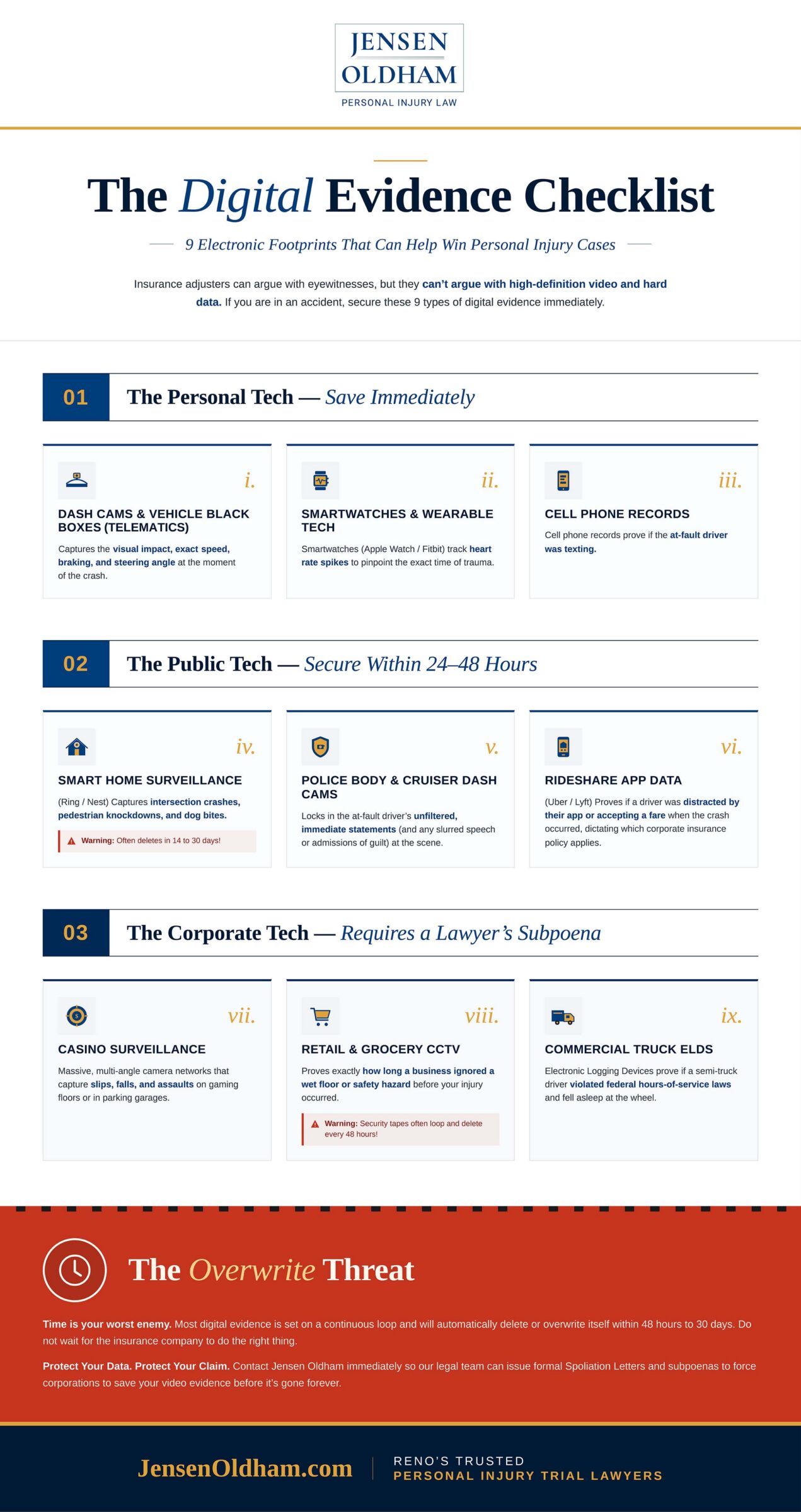
Electronic evidence has completely leveled the playing field for injury victims. Here are the nine most powerful types of digital evidence our firm uses to hold negligent parties and massive corporations accountable:
1. Dash Cams and Vehicle Telematics (Black Boxes)
As we discussed in our dedicated guide to dash cam evidence in court, video footage is an incredible tool for proving fault at tricky intersections. However, even if you don’t have a camera, some modern vehicles are equipped with an Event Data Recorder (EDR). This hard data can prove the exact speed the at-fault driver was traveling, whether they applied their brakes, and their steering angle at the moment of impact. If you are unsure whether your vehicle contains an EDR, the information can be found in your vehicle owner’s manual.
2. Smart Home Surveillance (Ring, Nest Doorbells)
Neighborhood crashes and pedestrian accidents frequently devolve into “he-said, she-said” arguments. Fortunately, smart home security cameras like Ring and Nest are motion-activated and face the street. They act as an unbiased third-party witness, frequently capturing exactly who ran a stop sign or how an unprovoked dog bite occurred.
3. Business CCTV and Security Cameras
If you suffer a slip-and-fall accident at a local gas station, restaurant, or retail store, the business almost certainly has security cameras. This footage is the foundation of a premises liability claim because it can prove exactly how long a hazard, like a spilled drink or a leaking roof, was ignored before you fell.
4. Smartphones and Wearable Tech
Your own devices provide powerful supporting evidence. An Apple Watch or Fitbit can show a massive spike in your heart rate to pinpoint the exact second a crash occurred and track your ongoing sleep disturbances to prove physical and emotional suffering. Additionally, the at-fault driver’s cell phone records can be subpoenaed to prove they were texting, browsing social media, or otherwise distracted when they hit you.
5. Casino Surveillance
Reno casinos boast some of the most advanced, high-definition camera networks on the planet. If you are injured on a gaming floor, in a hotel hallway, or in a resort parking garage, the incident was almost certainly caught from multiple angles. While the casinos have the footage, their corporate risk-management teams will fight relentlessly to keep it hidden, making a lawyer’s subpoena absolutely necessary.
6. Grocery Store & Retail Security Tapes
Unlike massive casinos, big-box retailers, and grocery stores often use cheaper camera systems that record on very short loops. These cameras are crucial for proving that a store knew about a smashed jar on aisle four but failed to clean it up in a reasonable amount of time.
7. Commercial Truck ELDs (Electronic Logging Devices)
Because of the heavy commercial traffic on I-80, trucking accidents are common in Northern Nevada. Federal law requires semi-trucks to have Electronic Logging Devices (ELDs) that digitally track a driver’s hours of service. If an exhausted trucker falls asleep at the wheel and rear-ends you, the ELD data can prove to the court that the driver and their corporate employer violated federal rest regulations.
8. Police Body Cameras and Cruiser Dash Cams
When the Reno Police Department or Nevada State Police arrive at the scene of a crash, their body cams and cruiser cameras are rolling. This is incredible digital evidence because it captures the at-fault driver’s immediate, unfiltered statements. If the other driver slurs their words, acts erratically, or admits fault to the officer, the body cam footage locks in their guilt before their insurance adjuster can coach them to lie.
9. Rideshare App Data
With heavy tourism between the Reno-Tahoe International Airport and local resorts, rideshare accidents are a daily occurrence. If an Uber or Lyft driver causes a crash, the digital data inside their app is a goldmine. It can prove whether they were staring at their GPS or distracted by accepting a new fare at the exact second the crash occurred. This data also legally dictates which multi-million-dollar corporate insurance policy applies to your claim.
The Overwrite Problem: Why You Must Act Quickly
When dealing with digital evidence, time is your absolute worst enemy.
Smart doorbell cameras like Ring often overwrite cloud data every 14 to 30 days. Gas station and small retail security cameras may loop and overwrite their recordings every 48 hours. Dash cams constantly overwrite old files as you drive. If you wait a few weeks to hire a lawyer or assume the police will collect all the video for you, the most crucial evidence of your accident will simply cease to exist.
THE SPOLIATION OF EVIDENCE RULE
If a business or an at-fault driver intentionally deletes digital evidence after they have been put on notice of a potential lawsuit, they can be penalized under the legal doctrine of spoliation.
If digital evidence in court is proven to have been intentionally destroyed to hide the truth, the judge can issue an adverse inference instruction. This tells the jury they should legally assume that the deleted video or data would have proven the defendant was entirely at fault for your injuries.
How We Force Corporations to Hand Over Video Evidence
You cannot simply walk into a major Reno casino or a corporate grocery chain and demand to see their security tapes. If you try, management will likely claim the camera wasn’t working or dismiss you entirely to protect their bottom line.
At Jensen Oldham, we use the law to help us gain access to this crucial evidence. The moment you hire us, one of our legal team’s first actions is to issue a Letter of Spoliation (also known as a preservation letter) to the at-fault party or business. This is a formal, legally binding document demanding that they preserve specific electronic evidence in anticipation of a lawsuit. It forces the corporation to lock down the footage under threat of severe legal and financial penalties.
Secure Your Evidence: Contact Jensen Oldham Today
Proving exactly what happened in the chaotic moments of an accident shouldn’t be a burden you carry alone while trying to heal from your injuries. Let our experienced Reno personal injury lawyers handle the investigation.
If you or a loved one has been injured, secure your personal devices, save your dash cam SD cards, and contact Jensen Oldham immediately. We will aggressively track down, subpoena, and secure the digital evidence required to support your claim. We offer completely free, confidential case evaluations, and you will not pay a single dime in attorney fees unless we successfully win your case.